Under the Digital Personal Data Protection (DPDP) Act, unrefined data has shifted from a strategic asset to a high-voltage financial liability. For fintechs, the challenge is no longer just internal database management it is the complex orchestration of consent across a web of Lenders, LSPs, and Co-lending partners.
For a decade, the fintech mantra was "collect everything, monetize later." In the era of India’s DPDP Act, that "oil" has become highly combustible. If ungoverned, a massive database is no longer a resource; it is a Rs. 250 crore enforcement risk.
For BFSI and Fintech leaders, the calculation has changed. A data breach or a failure to honor a "Right to Erasure" request is no longer an IT ticket it is a board-level exposure that can derail an IPO or wipe out annual profits. In 2026, Privacy is the most liquid asset a financial institution holds.
Fintech resides at the most volatile intersection of the digital economy: the convergence of financial data, behavioral patterns, and Personally Identifiable Information (PII).
Because of the volume and sensitivity of the data handled, most mid-to-large fintechs and NBFCs will almost certainly be classified by the Data Protection Board as Significant Data Fiduciaries (SDFs). This triggers a non-negotiable, heavy-duty compliance stack:
The complexity of the Indian fintech ecosystem with its reliance on third-party APIs, Lending Service Providers (LSPs), and co-lending partners means that compliance is no longer a perimeter defense. It is a systemic requirement.
The biggest operational hurdle in Fintech is that data rarely stays in one place. Modern lending is a relay race between Lending Service Providers (LSPs), Co-lenders, Credit Bureaus, and Collections Agencies.
The Challenge: If a user withdraws consent on your app, how does that signal propagate to your NBFC partner or your third-party recovery agent in real-time?
Under DPDP, the Data Fiduciary (The Fintech) bears the primary responsibility for the actions of its Data Processors (The Partners). If a partner mishandles data, the regulatory and reputational heat stays with you. Compliance in 2026 requires more than a UI fix; it requires a Consent Orchestration Layer that syncs every partner in the value chain.
Fintechs may avoid legacy banking mainframes, but they face a Fragmented Stack Crisis. PII often lives in silos: the Loan Management System (LMS), the CRM, and various partner S3 buckets.
The Risk: A user requests data erasure. You delete it from your primary database, but a week later, a partner's automated bot sends them a marketing SMS because the "Consent State" wasn't synchronized. This is a direct DPDP violation.
To mitigate this, firms are moving toward Stateful Middleware. This acts as a single source of truth for consent, ensuring that when a user toggles a privacy setting, every internal microservice and external API endpoint updates within milliseconds.
While the focus is often on penalties, leadership should recognize the competitive advantage:
Solving the DPDP challenge requires a shift from legal paperwork to Privacy Engineering. This involves:
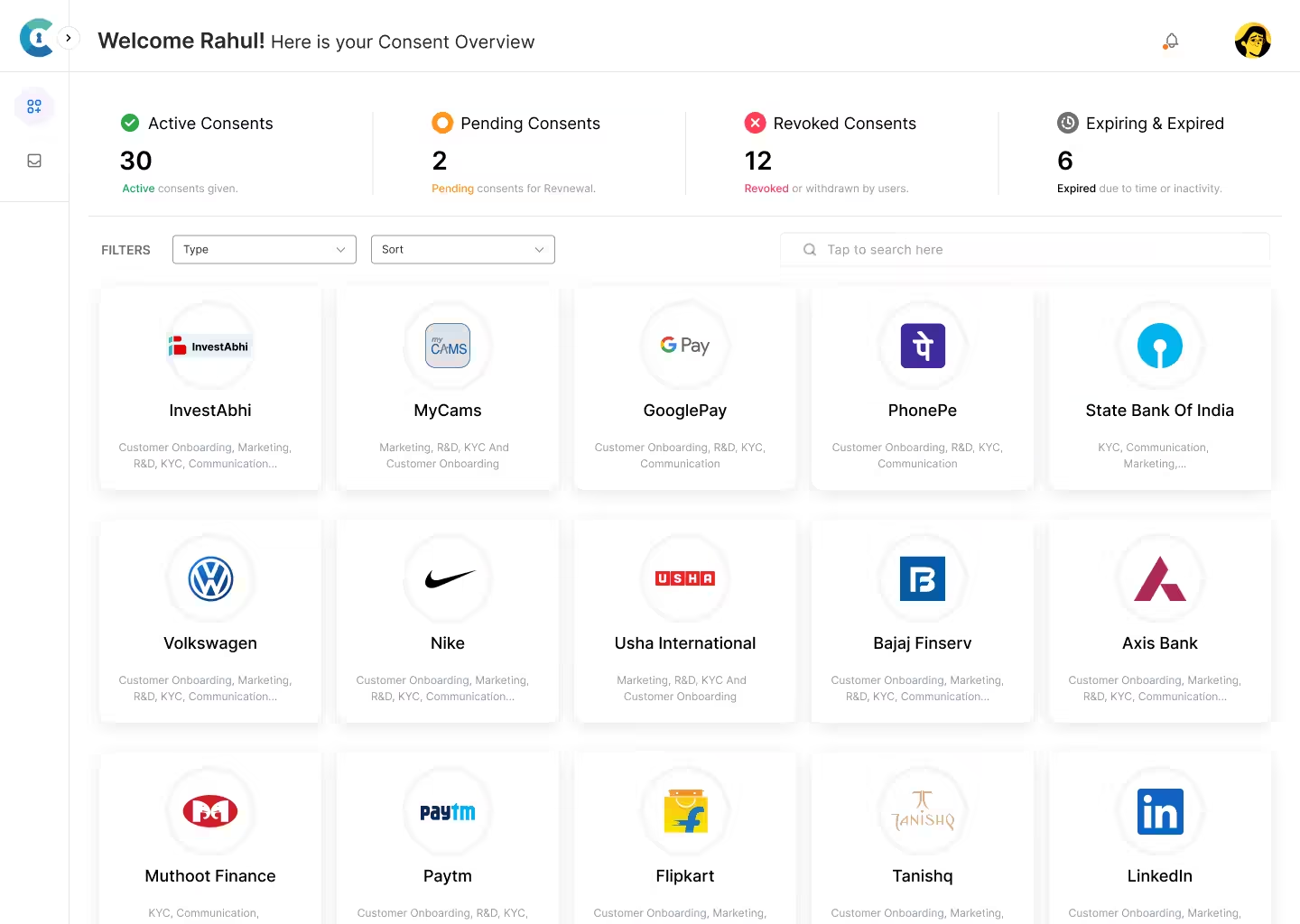
Products like ConsenPro have emerged to bridge this gap, providing the middleware and orchestration tools necessary to manage these complex data flows without requiring a total architectural overhaul. By treating privacy as a core product feature rather than a legal burden, Fintech leaders can turn compliance into their strongest competitive moat.
Subscribe for exclusive updates and insights. Stay informed about our latest offerings, partnership opportunities,